How to Build an Online Business from Scratch: The Complete Beginner’s Guide
If you’ve ever wondered how to build an online business, you’re certainly not alone. Millions of people dream of creating an income that isn’t limited by traditional working hours or a single employer. Whether your goal is to earn a little extra each month, replace your full-time salary, or build a business that generates income while you sleep, the internet has created opportunities that simply didn’t exist a decade ago.
The challenge isn’t that there are too few opportunities—it’s quite the opposite. Search online and you’ll quickly find thousands of videos, courses and social media posts claiming to reveal the “best” way to make money online. One person insists affiliate marketing is the answer, another promotes dropshipping, while someone else claims selling digital products or creating YouTube videos is the only path to success. For beginners, this flood of information often creates confusion rather than clarity.
Why Choosing the Right Online Business Model Matters
The truth is that there is no single online business model that works for everyone. The best choice depends on your interests, available time, budget, skills and long-term goals. Some businesses require very little money to start but demand patience before producing results. Others may require more investment upfront but can scale more quickly if managed well. Understanding these differences is one of the first steps towards making informed decisions instead of chasing unrealistic promises.
One of the greatest advantages of learning how to build an online business today is the wide range of affordable tools available. Website builders, AI assistants, email marketing platforms, design software and automation tools have made it possible for individuals to launch professional-looking businesses without needing advanced technical knowledge. Tasks that once required a team of designers, developers and marketers can now be completed by one person using beginner-friendly software.
However, tools alone do not build successful businesses. Sustainable online businesses are built on solving genuine problems, creating valuable content, building trust with an audience and choosing business models that match your strengths. Success rarely happens overnight, and anyone promising guaranteed riches with little effort should be viewed with caution. Like any business, online success usually requires learning, consistency and continuous improvement.
What You’ll Learn in This Guide to Building an Online Business
This comprehensive guide has been created to help you understand exactly how to build an online business from scratch. Instead of focusing on just one method, we’ll explore the most popular online business models available today, including affiliate marketing, blogging, dropshipping, Amazon FBA, digital products, print-on-demand, freelancing, content creation, AI-powered businesses and software affiliate programmes.
By the end of this guide, you’ll understand how each model works, its advantages and disadvantages, the tools commonly used, typical startup costs, and which business types are most suitable for different goals. You’ll also discover the common mistakes beginners make, realistic expectations for earning income online, and a practical roadmap to help you choose the right path with confidence.
Whether you’re starting with a limited budget, looking for a side income alongside your current job, or hoping to build a full-time online business in the future, this guide will provide a solid foundation to help you take your first steps.
What Is an Online Business?
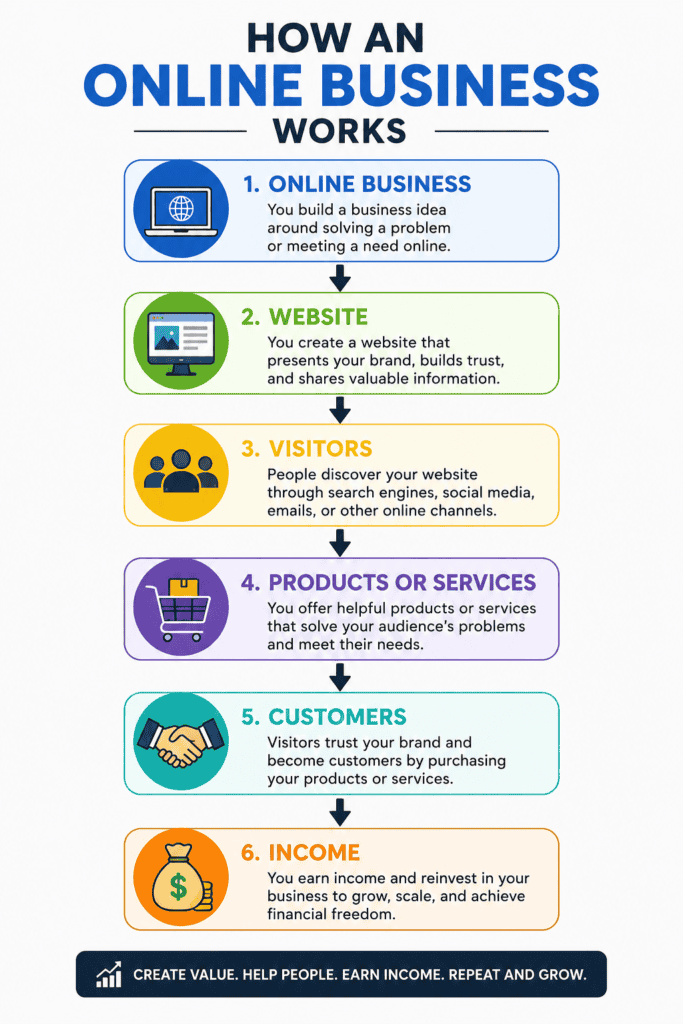
An online business is any business that uses the internet as its primary way of selling products, delivering services, generating leads or earning revenue. Unlike a traditional brick-and-mortar business that relies on a physical location, an online business allows customers to discover, interact with and purchase from you through websites, online marketplaces, social media platforms or digital applications.
One of the biggest misconceptions is that every online business looks the same. In reality, there are many different business models, each with its own advantages, challenges and income potential. Some businesses focus on selling physical products, while others specialise in digital products, services or affiliate marketing. Understanding these differences is essential before deciding which path is right for you.
For example, someone running an Amazon FBA business stores products in Amazon’s warehouses, while a blogger earns money by publishing helpful content and recommending products through affiliate links. A freelancer may sell skills such as graphic design or copywriting, whereas a digital creator could generate income by selling online courses, templates or downloadable resources. Although these businesses operate differently, they all share one common goal: using the internet to create value for customers while generating income.
Another important feature of an online business is its flexibility. Many online businesses can be managed from almost anywhere with a reliable internet connection. This flexibility has made online entrepreneurship increasingly attractive to people looking for additional income, career independence or the opportunity to build a business around their lifestyle.
However, flexibility should not be confused with simplicity. Building a successful online business still requires planning, consistency, problem-solving and a willingness to learn new skills. The internet has lowered the barriers to entry, but it has also increased competition. Success usually comes from providing genuine value rather than looking for shortcuts.
A successful online business is built on four key foundations:
- Solving a real problem for a specific audience.
- Building trust through valuable content, quality products or reliable services.
- Attracting visitors through marketing channels such as search engines, social media or email.
- Converting those visitors into customers while continuing to improve the customer experience.
Once these foundations are in place, an online business can often be expanded by introducing new products, reaching new audiences or automating repetitive tasks with modern software tools.
Why Are More People Starting Online Businesses?
Over the last decade, the way people work and shop has changed dramatically. Consumers now purchase products, book services, learn new skills and communicate with businesses online every day. This shift has created enormous opportunities for entrepreneurs who want to build businesses without the high overhead costs traditionally associated with physical stores.
One of the biggest reasons people choose to start an online business is accessibility. Years ago, launching a business often required renting premises, purchasing expensive equipment and investing significant amounts of money before serving a single customer. Today, many online businesses can be started with relatively modest costs using affordable website hosting, beginner-friendly software and digital marketing tools.
Technology has also levelled the playing field. Artificial intelligence, website builders, email marketing platforms, graphic design software and automation tools allow individuals to perform tasks that previously required specialist teams. As a result, one person can often manage marketing, customer communication, content creation and sales from a single laptop.
Another attraction is scalability. A physical business is often limited by opening hours, geographical location or available floor space. Online businesses can potentially reach customers nationally or internationally without opening additional locations. While scaling still requires effort and planning, the internet makes growth more achievable than ever before.
Many people are also motivated by financial diversification. Rather than relying solely on one salary, they choose to build additional income streams through blogging, affiliate marketing, dropshipping, digital products, online courses or consulting. Diversifying income can reduce dependence on a single employer and provide greater long-term financial resilience.
It’s equally important to understand that online businesses are not “get-rich-quick” schemes. Behind every successful website, YouTube channel or online store are countless hours spent learning, testing, improving and serving customers. Those who approach online business with realistic expectations are generally better prepared for sustainable long-term success than those searching for instant results.
Can You Start an Online Business With No Experience?
One of the most common questions beginners ask is whether it’s possible to build an online business without any previous experience. The encouraging answer is yes but it’s important to understand what “no experience” really means.
Most successful online entrepreneurs did not begin as experts. They started by learning one skill at a time, making mistakes, improving their knowledge and gradually building confidence through experience. Every successful website owner, affiliate marketer, content creator and e-commerce seller was once a complete beginner.
The internet offers access to an enormous range of free and affordable educational resources. Blogs, YouTube tutorials, podcasts, online communities and official product documentation allow beginners to learn essential skills such as website creation, search engine optimisation (SEO), email marketing, copywriting and content creation at their own pace.
Rather than trying to master everything at once, focus on developing a few core skills:
- Basic website management.
- Content creation.
- Search engine optimisation (SEO).
- Email marketing.
- Understanding your target audience.
- Basic analytics and performance tracking.
As your business grows, you can gradually learn more advanced topics or outsource specialist tasks when appropriate.
Another misconception is that successful entrepreneurs know exactly what they’re doing from the beginning. In reality, most businesses evolve through experimentation. You may adjust your niche, improve your website, refine your marketing strategy or even change business models as you gain more experience.
The most valuable quality for beginners is not technical expertise—it’s consistency. Those who continue learning, publishing content, testing ideas and improving over time are far more likely to succeed than those constantly searching for a perfect business opportunity before taking action.
Starting without experience is entirely possible. What matters most is your willingness to learn, adapt and remain committed to building something valuable over the long term.
What Are the Best Online Business Ideas for Beginners?
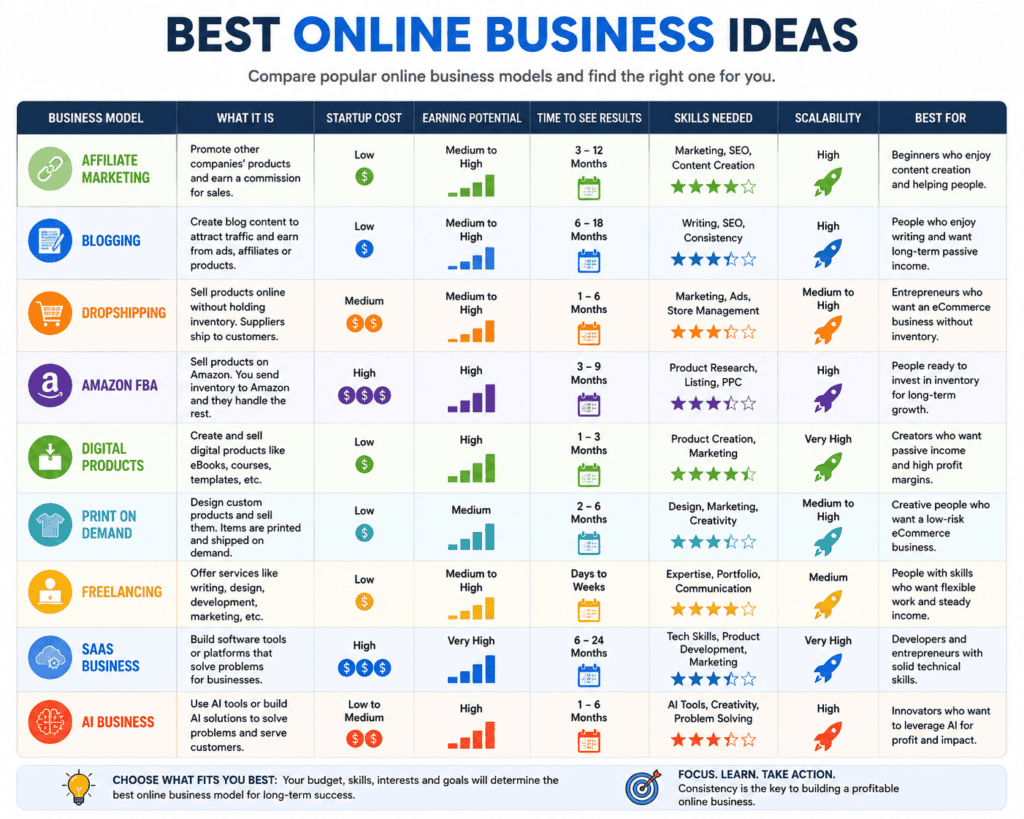
If you’ve been researching how to build an online business, you’ve probably come across dozens of different business models. One expert recommends affiliate marketing, another says dropshipping is the future, while others encourage selling digital products or starting a YouTube channel.
The reality is that there isn’t a single “best” online business. Every business model has its own advantages, challenges, startup costs and learning curve. The right choice depends on your interests, available time, budget, existing skills and long-term goals.
Some online businesses require little financial investment but take time to grow. Others require a larger upfront investment but can generate sales more quickly if managed well. Understanding these differences will help you make an informed decision instead of chasing whichever opportunity is currently trending on social media.
Below are some of the most popular online business models available today.
How to Build an Online Business with Affiliate Marketing
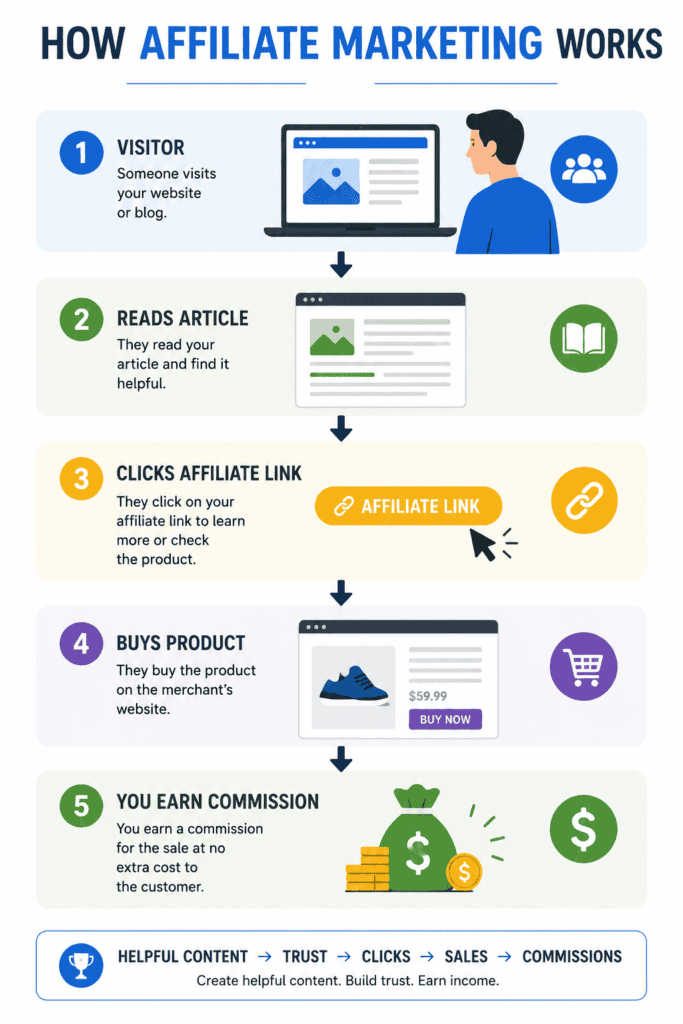
Affiliate marketing is one of the most popular ways to build an online business because you don’t need to create your own products or manage customer orders. Instead, you promote products or services offered by other companies and earn a commission whenever someone makes a qualifying purchase through your referral link.
Many well-known companies operate affiliate programmes covering industries such as software, web hosting, financial services, fashion, home products and education.
Affiliate marketing works particularly well alongside content creation. Rather than trying to sell directly, you create helpful blog articles, YouTube videos, email newsletters or social media posts that genuinely solve problems. Within that helpful content, you recommend products or services that readers may find useful.
For example, someone writing an article about starting a website could naturally recommend a web hosting company. A YouTube creator reviewing video editing software may include affiliate links in the video description. Because these recommendations are relevant to the content, they can feel more helpful than traditional advertising.
Advantages of affiliate marketing
- Low startup costs.
- No inventory to purchase.
- No customer support for products you don’t own.
- Can generate income from evergreen content.
- Can be combined with blogging, YouTube or email marketing.
Challenges
- Building traffic takes time.
- Income depends on visitors trusting your recommendations.
- Affiliate programmes can change their commission structures.
- High competition in some niches.
Affiliate marketing is often an excellent choice for beginners who enjoy writing, teaching or creating helpful online content.
Blogging
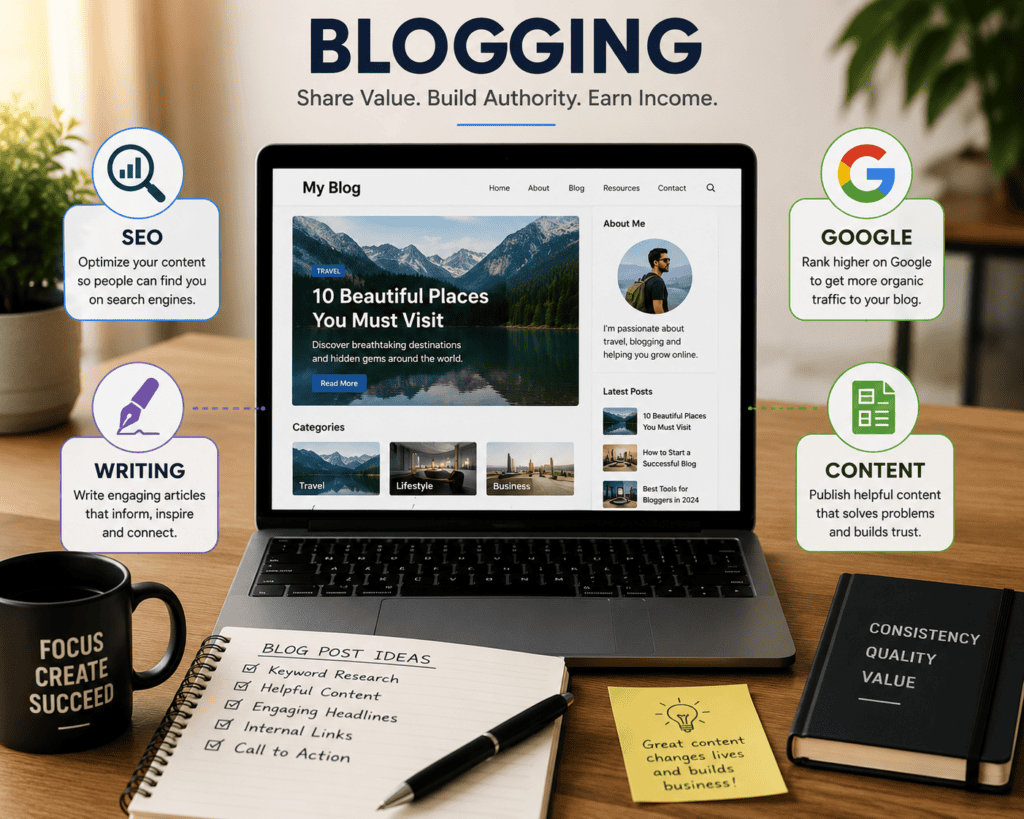
Despite the growth of social media, blogging remains one of the most effective ways to build long-term online traffic through search engines. A well-written article can continue attracting visitors for months or even years after publication.
A blog allows you to demonstrate expertise, answer common questions and build trust with readers before recommending products or services. Unlike social media posts, which often disappear within hours or days, high-quality blog content can continue generating visitors over the long term.
Successful blogs often generate income from multiple sources, including:
- Affiliate marketing
- Display advertising
- Sponsored content
- Digital products
- Online courses
- Email marketing
- Membership communities
The key to successful blogging is consistency. Publishing genuinely helpful content that answers real questions is far more effective than producing large volumes of low-quality articles.
Dropshipping
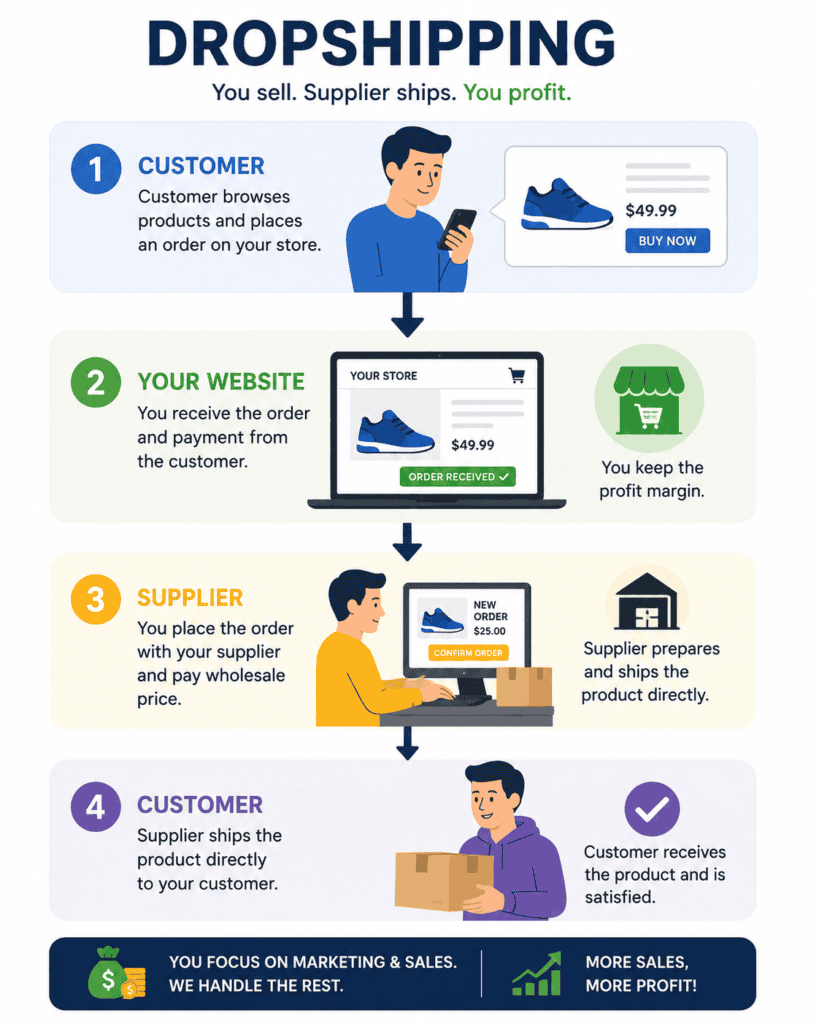
Dropshipping is an e-commerce business model where you sell physical products without keeping inventory yourself. Instead of storing products in your own warehouse or home, you partner with a supplier who holds the stock. When a customer places an order through your online store, the supplier packages and ships the product directly to the customer.
This means you never physically handle the product, making dropshipping an attractive option for entrepreneurs who want to sell physical goods without investing heavily in inventory.
How does dropshipping work?
The process is relatively straightforward:
- You create an online store and list products for sale.
- A customer places an order on your website.
- You forward the order details to your supplier.
- The supplier packs and ships the product directly to the customer.
- You keep the difference between the selling price and the supplier’s cost, after deducting business expenses.
Advantages of dropshipping
- No need to purchase stock in advance.
- Lower startup costs than traditional retail.
- Large product selection.
- Can operate from almost anywhere.
- Easy to test different products.
Challenges
Dropshipping is often promoted as an easy way to make money online, but the reality is more complex.
Competition can be intense, particularly when many stores sell identical products from the same suppliers. Profit margins may also be lower than businesses selling their own branded products. Customer satisfaction depends heavily on supplier reliability, shipping times and product quality factors that are not always fully within your control.
Successful dropshipping businesses usually differentiate themselves through strong branding, excellent customer service, high-quality product selection and effective marketing rather than simply competing on price.
For beginners interested in e-commerce without purchasing inventory upfront, dropshipping can provide valuable experience in running an online store and understanding digital marketing.
Amazon FBA (Fulfilment by Amazon)
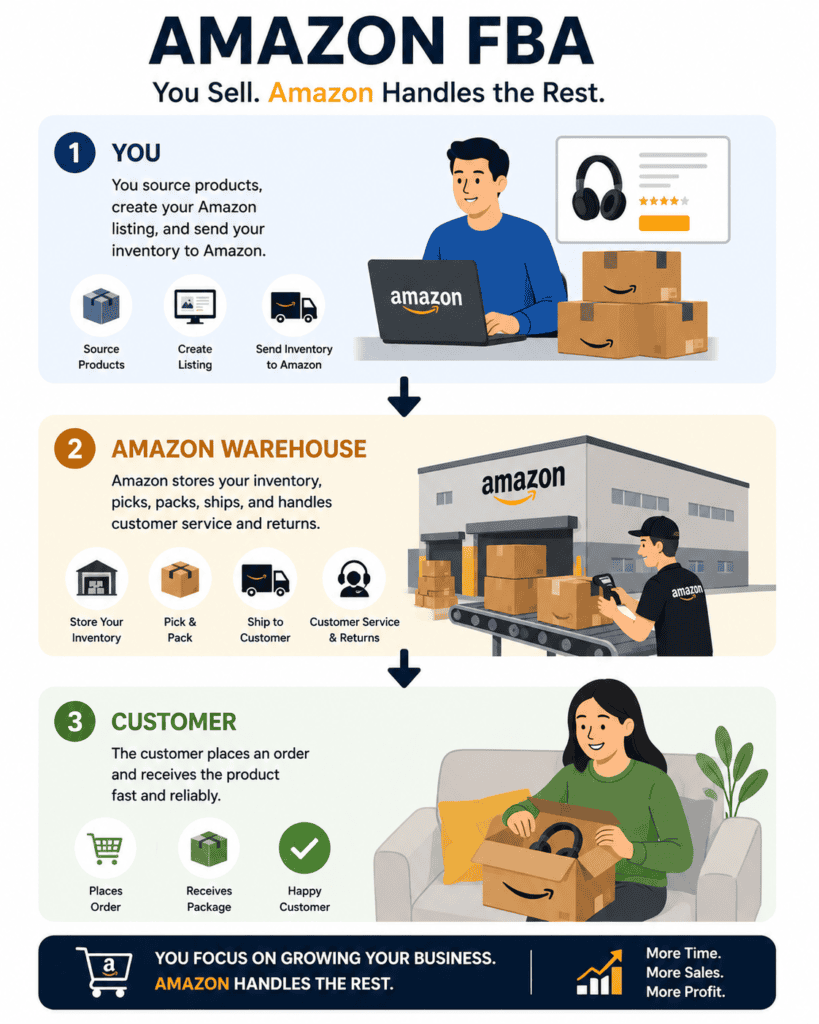
Amazon FBA is another popular e-commerce business model, but it works very differently from dropshipping.
Instead of relying on a supplier to ship each order, you purchase inventory in advance and send it to Amazon’s fulfilment centres. When customers buy your products, Amazon stores, packs and delivers the orders on your behalf. They also handle much of the customer service and returns process.
Many entrepreneurs choose Amazon FBA because it gives them access to one of the world’s largest online marketplaces. Millions of customers already shop on Amazon every day, meaning you don’t need to convince people to trust an unfamiliar website before making a purchase.
Advantages of Amazon FBA
- Access to Amazon’s large customer base.
- Fast shipping through Amazon’s fulfilment network.
- Reduced day-to-day order fulfilment.
- Opportunity to build your own branded products.
- Potential to scale successful products.
Challenges
Amazon FBA also comes with important considerations.
Selling on Amazon involves various fees, including fulfilment fees, storage charges and selling fees. Competition can be intense in many product categories, and success often depends on choosing products carefully, optimising listings and managing advertising effectively.
Unlike affiliate marketing or blogging, Amazon FBA usually requires purchasing inventory upfront, making it a higher-risk business model for some beginners. However, for entrepreneurs who want to build a physical product brand, it remains one of the most established online business opportunities available.
Selling Digital Products
Selling digital products has become one of the fastest-growing online business models because you create a product once and can sell it repeatedly without worrying about inventory, packaging or shipping. Unlike physical products, digital products are delivered instantly to customers, making them highly scalable.
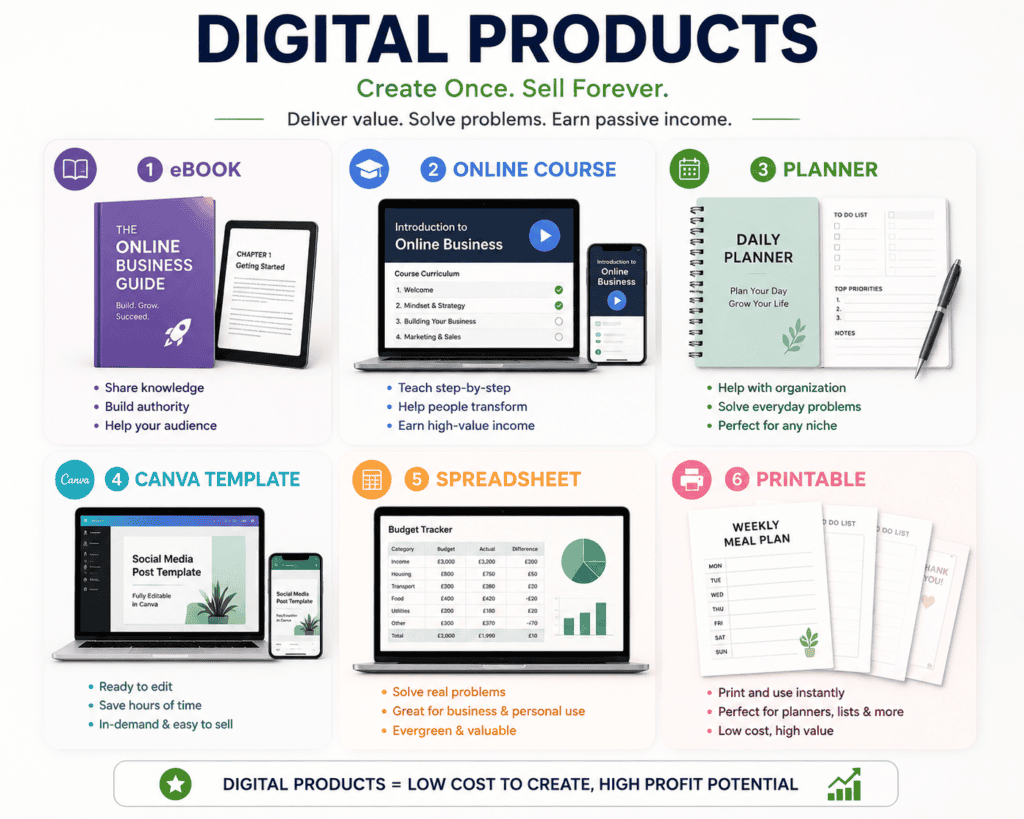
Digital products can take many forms, including eBooks, templates, planners, spreadsheets, online courses, digital artwork, stock photos, printable, prompt libraries, checklists and business resources. As long as the product provides genuine value and solves a problem, there is potential to build a sustainable business around it.
One of the biggest advantages is that profit margins are often higher than with physical products. After covering the initial cost of creating the product and the platform used to sell it, each additional sale can generate income without the ongoing production costs associated with physical goods.
Advantages of selling digital products
- No inventory or shipping.
- High profit potential.
- Products can be sold worldwide.
- Easy to update and improve over time.
- Can be combined with blogging, YouTube or email marketing.
Challenges
Creating a high-quality digital product takes time and planning. Success depends on understanding your audience’s needs, producing valuable content and marketing your products effectively. Competition is increasing, so quality and trust are more important than ever.
Selling digital products is an excellent option for people who enjoy teaching, designing, writing or sharing their expertise.
Print-on-Demand
Print-on-demand (POD) allows entrepreneurs to sell customised products such as T-shirts, hoodies, mugs, tote bags, notebooks and phone cases without purchasing inventory in advance.
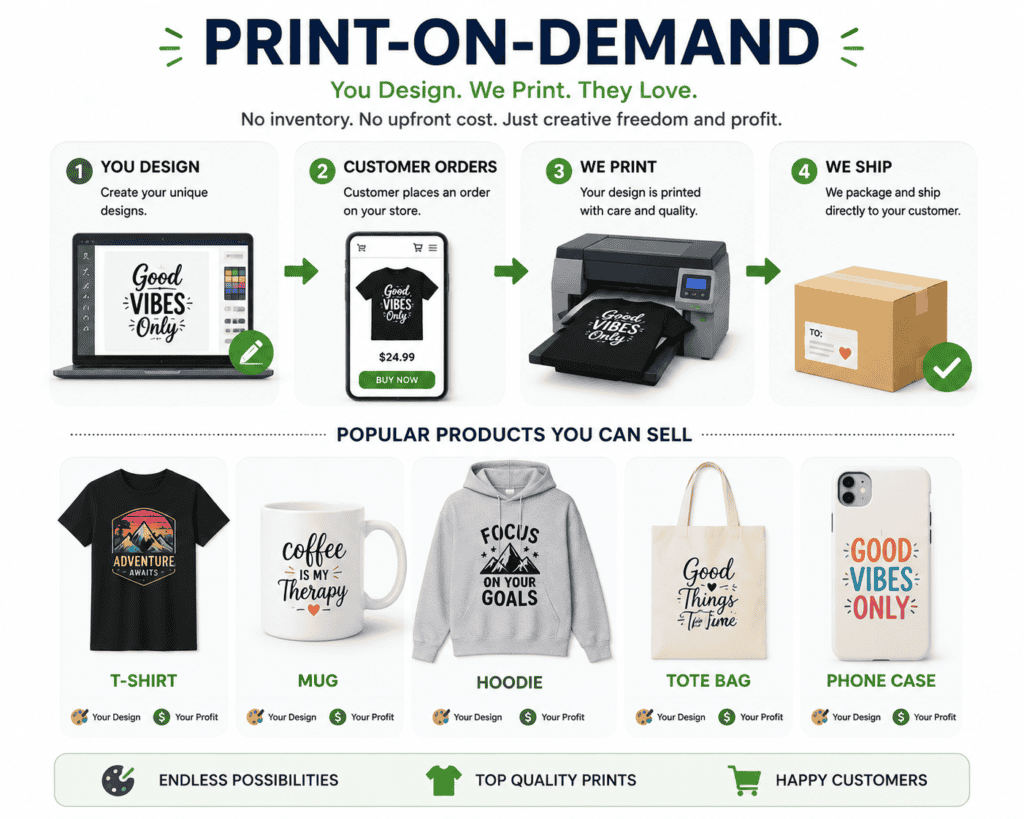
When a customer places an order, the print-on-demand company prints the design onto the chosen product and ships it directly to the customer. Similar to dropshipping, you don’t need to manage stock or fulfil orders yourself.
Many creators use print-on-demand to build lifestyle brands, sell merchandise to their audience or create niche product collections based on hobbies, professions or interests.
Advantages
- No inventory required.
- Low financial risk.
- Wide range of products.
- Easy to launch new designs.
- Ideal for creative entrepreneurs.
Challenges
Profit margins are generally lower than manufacturing your own products, and success often depends on creating unique designs that appeal to a specific audience. Building a recognisable brand is usually more effective than simply uploading hundreds of generic designs.
Freelancing
Freelancing is one of the quickest ways to start earning money online because you’re selling your skills rather than physical or digital products. Businesses around the world regularly hire freelancers for short-term or ongoing projects.
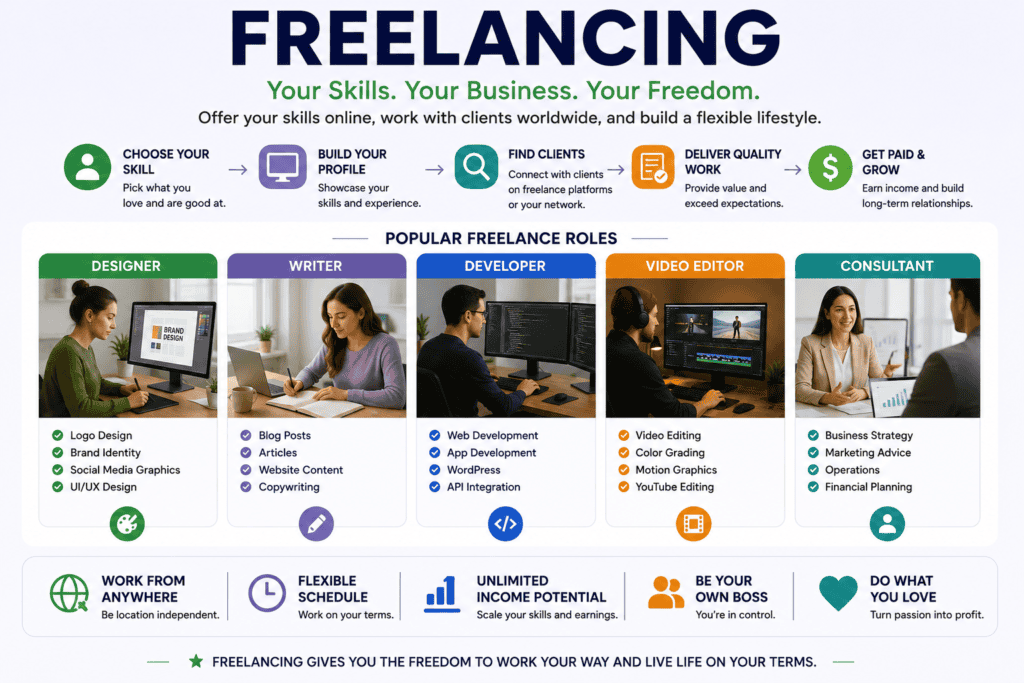
Popular freelance services include:
- Copywriting
- Graphic design
- Website development
- Search engine optimisation (SEO)
- Video editing
- Virtual assistance
- Social media management
- Translation
- Bookkeeping
- Digital marketing
Unlike some business models that take months to gain traction, freelancers can often begin earning once they secure their first client.
Advantages
- Low startup costs.
- Fastest route to earning income.
- Flexible working hours.
- Opportunity to specialise in a particular field.
- Can grow into an agency over time.
Challenges
Freelancing often means exchanging time for money. Income may fluctuate depending on client demand, and building a strong reputation takes consistent effort. Many freelancers eventually expand into digital products, online courses or agencies to create additional income streams
SaaS Affiliate Marketing
Software as a Service (SaaS) affiliate marketing focuses on recommending subscription-based software products like System io rather than physical goods. Many software companies reward affiliates with recurring commissions as long as the referred customer remains subscribed.
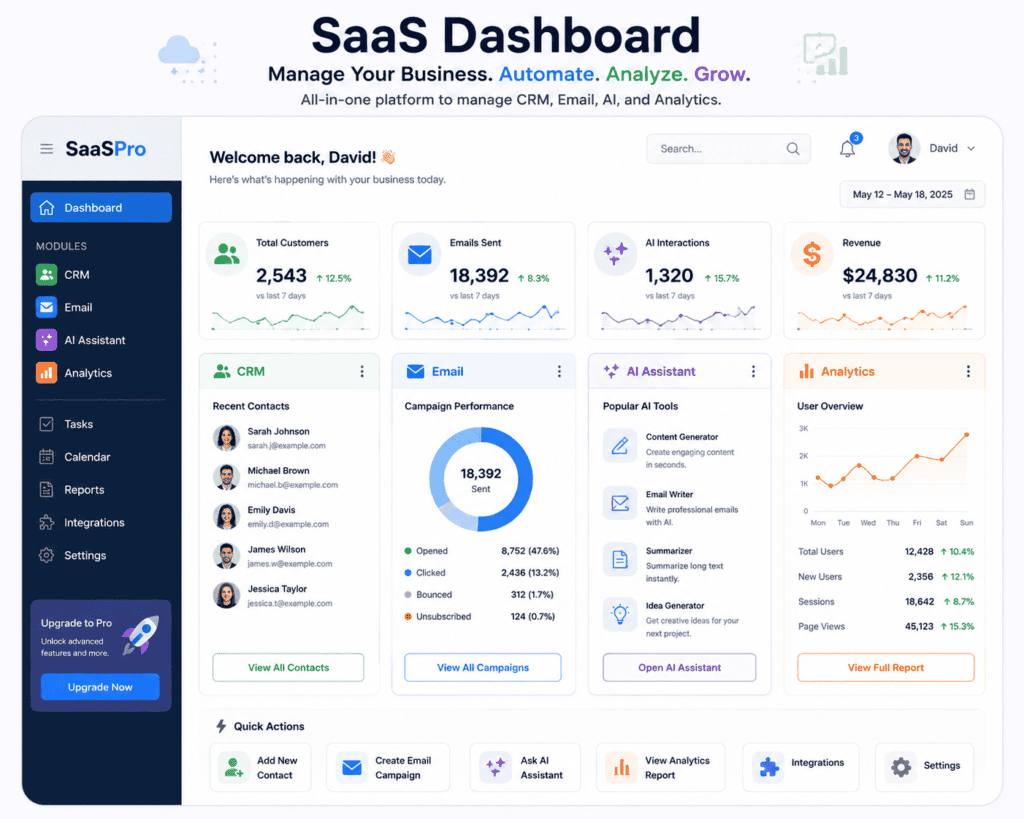
Examples of SaaS categories include:
- Website builders
- Email marketing platforms
- AI writing assistants
- Graphic design software
- Video editing tools
- Customer relationship management (CRM) software
- Productivity applications
Recurring commissions can make SaaS affiliate marketing attractive because a single referral may continue generating income for months or even years, depending on the programme’s terms.
However, success depends on recommending software that genuinely meets your audience’s needs. Honest reviews, tutorials and case studies generally perform better than overly promotional content.
AI-Powered Online Businesses
Artificial intelligence has transformed many aspects of online business. Rather than replacing entrepreneurs, AI is increasingly being used to improve productivity, automate repetitive tasks and enhance creativity.
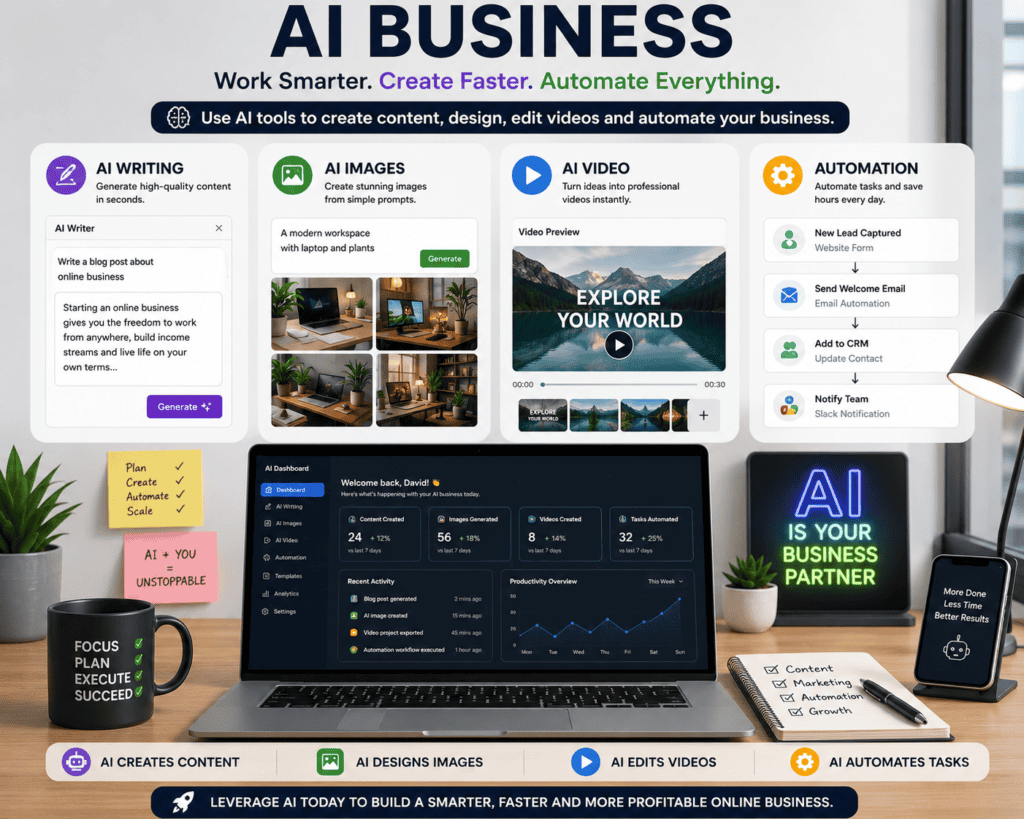
Examples of AI-supported businesses include:
- AI-assisted content writing.
- AI image generation.
- AI video creation.
- AI voiceovers.
- Customer support automation.
- Workflow automation.
- AI consulting services.
It’s important to remember that AI works best when combined with human judgement, creativity and expertise. Businesses that rely entirely on automated, low-quality content may struggle to build trust with customers or perform well in search results.
When used responsibly, AI can help entrepreneurs save time and focus on higher-value activities such as strategy, customer service and product development.
Content Creation
Content creation has become a business in its own right. Many entrepreneurs build audiences by publishing valuable content on platforms such as YouTube, TikTok, Instagram, Pinterest or through podcasts and blogs.
Instead of selling immediately, creators focus on educating, entertaining or inspiring their audience. As trust grows, multiple income opportunities often follow.
These may include:
- Advertising revenue.
- Affiliate marketing.
- Brand partnerships.
- Sponsorships.
- Merchandise.
- Digital products.
- Membership communities.
- Online courses.
Building an audience requires patience and consistency. While some creators experience rapid growth, many successful channels are the result of months or years of regular publishing.
Membership Websites
Membership websites provide subscribers with exclusive content in exchange for a recurring monthly or annual fee.
Members may receive:
- Premium tutorials.
- Downloadable resources.
- Community forums.
- Live workshops.
- Coaching sessions.
- Exclusive newsletters.
- Templates and toolkits.
Membership businesses can create predictable recurring income while fostering a loyal community. However, maintaining member satisfaction requires consistently delivering fresh, valuable content
Selling Online Courses
If you have experience or expertise in a particular subject, creating an online course can be an effective way to share your knowledge while building a scalable business.
Courses are available across countless topics, including:
- Photography.
- Cooking.
- Languages.
- Programming.
- Fitness.
- Music.
- Business.
- Marketing.
- Personal development.
A successful course solves a specific problem and guides learners towards a clear outcome. High-quality video lessons, downloadable resources and ongoing support can improve both student satisfaction and course completion rates.
Creating a course requires planning and effort, but once developed, it can become a valuable long-term asset that complements other parts of your online business.
Which Online Business Model Is Right for You?
Choosing the right online business depends on your personal circumstances rather than following the latest trend. Asking yourself a few simple questions can help narrow your options:
- Do you enjoy writing and educating others? Blogging or affiliate marketing may be a good fit.
- Are you creative and enjoy designing? Print-on-demand or digital products could suit you.
- Do you prefer selling physical products? Dropshipping or Amazon FBA might be worth exploring.
- Do you have a valuable skill? Freelancing could provide the quickest path to earning income.
- Do you enjoy creating videos? Content creation may open multiple revenue opportunities.
- Do you have specialist knowledge? Online courses or membership websites could be appropriate.
The most successful entrepreneurs don’t usually try every business model at once. Instead, they choose one, develop their skills, refine their systems and expand gradually as their experience grows.
How Much Money Do You Need to Start an Online Business?
One of the biggest myths about starting an online business is that you need a large amount of money before you can begin. While some businesses require significant investment, many successful online businesses have been started with a relatively modest budget and gradually expanded over time.
The amount of money you’ll need depends entirely on the business model you choose. For example, launching an Amazon FBA business usually requires purchasing inventory, paying shipping costs and covering marketplace fees. In contrast, affiliate marketing or blogging can often be started with little more than a domain name, web hosting and a willingness to create valuable content consistently.
Rather than asking, “How much money do I need?”, a better question is, “What type of online business fits my current budget and goals?” Starting with a business model that matches your financial situation can reduce unnecessary pressure while giving you valuable experience.
It’s also important to remember that money isn’t the only investment required. Time, patience and continuous learning are equally valuable. Many businesses fail not because they lacked funding, but because the owner expected immediate results and stopped too soon.
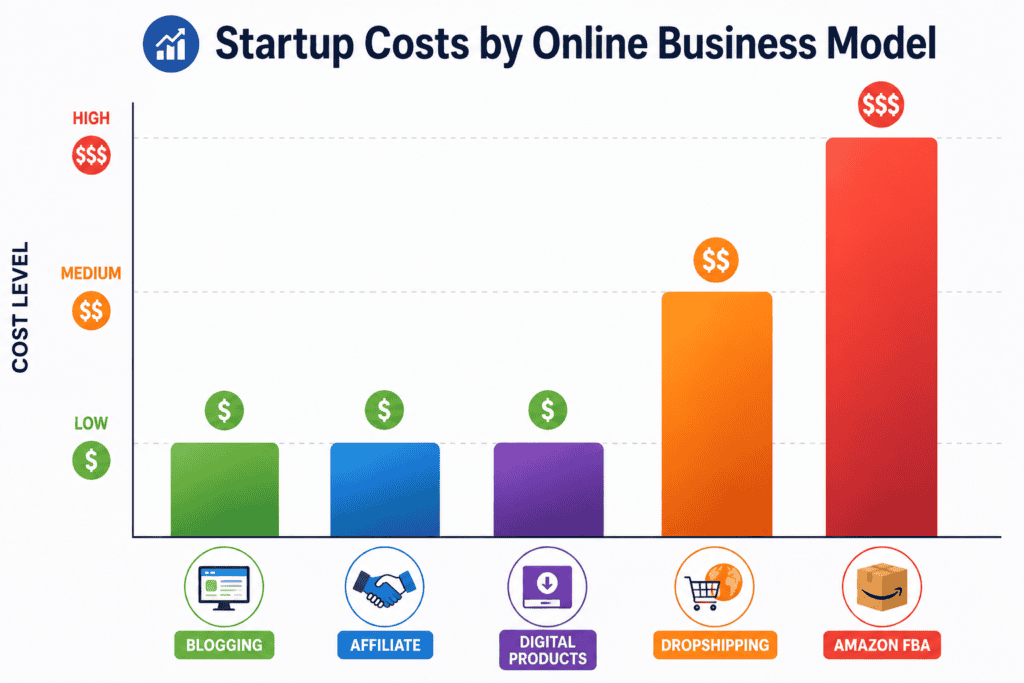
Typical Startup Costs by Business Model
The table below provides a general comparison of common online business models. Actual costs will vary depending on the tools, suppliers and services you choose.
| Business Model | Typical Startup Cost | Main Expenses |
|---|---|---|
| Affiliate Marketing | Low | Domain name, website hosting, email marketing |
| Blogging | Low | Hosting, domain, website theme, SEO tools (optional) |
| Digital Products | Low | Design software, selling platform, website |
| Freelancing | Low | Portfolio website, professional software |
| Content Creation | Low to Medium | Camera, microphone, editing software (optional) |
| Print-on-Demand | Low | Website, marketing, design software |
| Dropshipping | Low to Medium | Website platform, supplier apps, advertising |
| Amazon FBA | Medium to High | Inventory, shipping, Amazon fees, branding |
| Online Courses | Medium | Recording equipment, hosting platform |
| Membership Website | Medium | Website, membership software, ongoing content |
The encouraging news is that many of these costs can be spread over time. Instead of purchasing every tool immediately, focus on buying only what you genuinely need at your current stage.
Should You Start With Free Tools?
Many software companies now offer free plans that allow beginners to explore online business without making a large financial commitment.
Free plans can be an excellent way to:
- Learn how different platforms work.
- Develop new skills.
- Build your first website or landing page.
- Experiment with content creation.
- Validate a business idea before investing more money.
However, it’s important to recognise the limitations of free plans. They often include restricted features, storage limits or branding from the software provider. As your business grows, upgrading to paid plans may become necessary to unlock additional functionality and improve the customer experience.
The goal shouldn’t be to avoid spending money forever. Instead, aim to invest when those investments help your business grow or save you significant time.
Should You Take Out a Loan to Start?
For most beginners, borrowing money to start an online business is rarely necessary.
Many online business models can be launched gradually while you continue working in your current job. This approach reduces financial pressure and allows you to learn without depending on immediate income from your new venture.
Borrowing money may increase stress, especially if your business takes longer than expected to become profitable. A more sustainable strategy is to reinvest profits back into your business as it grows. Many successful entrepreneurs began with a small budget, generated their first sales and then used those earnings to improve their websites, marketing or product range.
Invest in Knowledge Before Expensive Software
One of the most valuable investments you can make isn’t necessarily another subscription or premium tool it’s improving your knowledge.
Learning how to write useful content, understand your audience, optimise for search engines and communicate effectively with customers will often have a greater long-term impact than purchasing software you don’t yet know how to use.
Modern software can make many tasks easier, but no tool can replace a clear business strategy or an understanding of what your customers need.
Start Small, Then Scale
Many successful online businesses didn’t begin with a team of employees, expensive offices or large advertising budgets. They started with one person taking consistent action over time.
You don’t need to launch ten products, create hundreds of blog posts or advertise on every social media platform from day one.
Instead, focus on building one solid foundation:
- Choose one business model.
- Create one website.
- Publish helpful content consistently.
- Learn from your audience.
- Improve your systems over time.
- Reinvest your profits into future growth.
Building gradually often leads to stronger businesses than trying to expand too quickly before establishing a reliable foundation.
Think of Your Online Business as a Long-Term Investment
Every article you publish, every video you create, every product you develop and every customer you help becomes an asset that can continue generating value in the future.
Unlike many traditional jobs where income stops when you stop working, certain online business assets—such as blog articles, digital products, online courses and evergreen videos—can continue attracting visitors and generating revenue long after they are created.
This is why many entrepreneurs focus on building assets rather than simply chasing short-term sales. Over time, these assets can work together to create multiple income streams and support the long-term growth of your business.
What Tools Do You Need to Build an Online Business?
One of the biggest advantages of starting an online business today is the wide range of affordable tools available. Tasks that once required professional designers, developers, marketers and accountants can now be completed by one person using beginner-friendly software.
However, one mistake many new entrepreneurs make is signing up for too many subscriptions before they’ve built the foundations of their business. Having dozens of premium tools won’t guarantee success if you haven’t yet identified your audience, created valuable content or developed a clear business strategy.
The goal isn’t to own the most software—it’s to choose tools that help you work more efficiently and solve real problems.
Below are the main categories of tools that many online businesses use as they grow.
Website Builders and Web Hosting
A website acts as the home of your online business. While social media platforms are valuable for reaching new audiences, you don’t own those platforms or control how they operate. Algorithms change, accounts can be restricted and platforms rise and fall in popularity.
Your website is different. It gives you complete control over your content, branding and customer experience.
Most online businesses benefit from having a website, whether they sell products, publish articles, offer services or collect email subscribers.
When choosing a website platform, consider factors such as:
- Ease of use.
- Speed and reliability.
- Mobile responsiveness.
- Search engine optimisation (SEO) features.
- Security.
- Ability to grow with your business.
Many entrepreneurs start with a simple website and expand it gradually as their business develops.
Email Marketing Platforms
Social media followers are valuable, but your email list is one of the few audiences you truly own.
An email marketing platform allows you to:
- Welcome new subscribers.
- Share helpful content.
- Announce new products.
- Recommend useful resources.
- Build long-term relationships.
- Stay connected even if social media algorithms change.
Unlike social media posts that may only be seen by a small percentage of your audience, email allows you to communicate directly with people who have chosen to hear from you.
Building an email list from the beginning gives your business an asset that can continue growing for years.
Graphic Design Software
Professional-looking visuals help establish credibility and improve the overall appearance of your brand.
Graphic design software can be used to create:
- Blog graphics.
- Social media posts.
- YouTube thumbnails.
- Product mock-ups.
- Presentations.
- eBooks.
- Digital products.
- Infographics.
Modern design tools are designed for beginners and often include ready-made templates, making it possible to create attractive visuals without advanced design experience.
Consistency is more important than complexity. A clean, recognisable visual style helps people remember your brand.
Artificial Intelligence (AI) Tools
Artificial intelligence has become one of the most significant developments in online business.
Used responsibly, AI can help entrepreneurs:
- Brainstorm ideas.
- Improve writing.
- Summarise information.
- Generate outlines.
- Translate content.
- Create images.
- Produce voiceovers.
- Assist with coding.
- Analyse data.
- Automate repetitive tasks.
AI should be viewed as an assistant rather than a replacement for human expertise. The best results usually come when AI supports your creativity and decision-making rather than producing content without review.
Businesses that combine AI with original ideas, personal experience and genuine value are more likely to build long-term trust with their audience.
Video Creation and Editing Tools
Video content continues to grow across platforms such as YouTube, TikTok, Instagram and Facebook.
You don’t necessarily need expensive cameras or professional editing equipment to begin. Many successful creators start with simple recording equipment and gradually improve their production quality over time.
Video editing software can help you:
- Trim recordings.
- Add captions.
- Include transitions.
- Improve audio.
- Create educational tutorials.
- Produce product demonstrations.
- Share customer stories.
As confidence grows, video can become an excellent way to build trust and demonstrate expertise.
SEO and Keyword Research Tools
Creating helpful content is only part of the process. People also need to be able to find it.
Search engine optimisation (SEO) tools help website owners understand:
- What people are searching for.
- Which keywords have potential.
- How webpages perform.
- Technical issues affecting visibility.
- Internal linking opportunities.
- Content improvements.
SEO is not about manipulating search engines. It’s about making your content easier for both search engines and users to understand while answering genuine questions better than competing pages.
Even basic keyword research can significantly improve the chances of your content reaching the right audience.
Analytics Tools
You cannot improve what you don’t measure.
Analytics tools provide valuable insights into how people interact with your website, including:
- Number of visitors.
- Traffic sources.
- Most popular pages.
- Time spent on each page.
- Device types.
- Visitor locations.
- Conversion rates.
Understanding this information allows you to identify what’s working, what needs improvement and where new opportunities may exist.
Rather than guessing, you can make decisions based on real data.
Productivity and Project Management Tools
As your online business grows, keeping track of ideas, deadlines and projects becomes increasingly important.
Productivity tools can help you organise:
- Content calendars.
- Marketing campaigns.
- Product launches.
- Daily tasks.
- Team collaboration.
- Customer projects.
- Business documentation.
Good organisation reduces stress and helps ensure important tasks don’t get overlooked.
Choosing the Right Tools for Your Stage of Business
One of the easiest ways to waste money is by purchasing software simply because someone else recommends it.
Instead, ask yourself a few practical questions:
- Does this tool solve a problem I currently have?
- Will it save me meaningful time?
- Can I achieve the same result with a simpler solution?
- Will I actually use it regularly?
- Is there a free version I can start with?
Remember that software is there to support your business not become your business.
Many successful entrepreneurs begin with only a handful of carefully chosen tools and expand their toolkit as their needs evolve.
The most important investment is not the software itself but your ability to use it effectively while continuing to create value for your audience.
How to Build an Online Business Step by Step
Building an online business can seem overwhelming when you’re first starting out. There are websites to create, products to choose, content to publish and countless tools claiming to make the process easier. It’s no surprise that many beginners spend months researching without ever taking the first step.
The good news is that every successful online business follows a similar journey. While the details may vary depending on whether you choose affiliate marketing, dropshipping, Amazon FBA or digital products, the underlying process remains remarkably consistent.
Instead of trying to do everything at once, focus on building one foundation at a time. Each step builds upon the previous one, helping you develop a business that can grow sustainably over the long term.
Step 1: Decide Why You Want to Build an Online Business
Before choosing products or building a website, take a moment to define your goal.
Ask yourself:
- Are you looking for extra income alongside your current job?
- Do you hope to build a full-time business one day?
- Would you like more flexibility to work from anywhere?
- Are you creating a business around a passion or hobby?
- Do you want to build long-term assets that can continue generating income?
Your answers will influence many of the decisions you make later.
For example, someone looking for an additional £500 per month may choose a different business model from someone hoping to build a nationally recognised e-commerce brand.
Having a clear purpose also helps maintain motivation during periods when progress feels slow.
Step 2: Choose the Right Business Model
One of the biggest mistakes beginners make is trying to run several online businesses simultaneously before they’ve gained experience.
Instead, choose one model that matches your current circumstances.
For example:
- If you enjoy writing and educating others, blogging and affiliate marketing could be a good fit.
- If you enjoy creating resources, selling digital products may suit you.
- If you prefer physical products, consider dropshipping or Amazon FBA.
- If you have a professional skill, freelancing may provide the fastest route to income.
- If you enjoy creating videos, content creation could open several revenue opportunities.
No business model is perfect. Rather than searching endlessly for the “best” opportunity, choose one that you can commit to consistently over the coming months.
Step 3: Choose a Niche
A niche is the specific topic or market your business will serve.
Many beginners worry that choosing a niche means limiting their opportunities. In reality, specialising often makes it easier for people to understand what your business offers.
Examples include:
- Home and kitchen products.
- Personal finance.
- Fitness.
- Gardening.
- Pet care.
- Technology.
- Digital marketing.
- Travel.
- Parenting.
- Mental wellbeing.
When selecting a niche, ask yourself three questions:
- Does this topic genuinely interest me?
- Are people actively searching for information or products in this area?
- Can I consistently create valuable content around this subject?
Choosing a niche that combines personal interest with genuine market demand often provides the strongest foundation.
Step 4: Build Your Website
Your website is your business’s digital home.
Whether you’re publishing blog articles, selling products, collecting email subscribers or promoting affiliate offers, your website gives you complete control over your content and branding.
When creating your website, focus on simplicity.
Your website should include:
- A clear homepage.
- An About page.
- Contact information.
- Privacy Policy.
- Helpful blog content.
- Clear navigation.
- Mobile-friendly design.
- Fast loading speeds.
Remember that your first website doesn’t need to be perfect. Many successful businesses began with simple websites that improved over time.
Step 5: Create Helpful Content
Content is often the engine that drives long-term online business growth.
Rather than focusing solely on selling, aim to answer the questions your audience is already asking.
Examples include:
- Step-by-step tutorials.
- Buying guides.
- Product comparisons.
- Frequently asked questions.
- Beginner guides.
- Industry news.
- Case studies.
- Troubleshooting articles.
Helpful content builds trust. Over time, readers who consistently find value in your articles or videos are more likely to return, subscribe and eventually become customers.
Quality is almost always more important than quantity.
One outstanding article that genuinely solves a problem can outperform dozens of short, superficial posts.
Step 6: Learn Basic SEO
Search Engine Optimisation (SEO) helps people discover your content through search engines.
Although SEO can seem technical at first, its core purpose is simple: helping people find useful information.
Some SEO fundamentals include:
- Understanding what people search for.
- Writing comprehensive, helpful content.
- Using descriptive headings.
- Creating clear page titles.
- Optimising images.
- Linking related articles together.
- Improving page speed.
- Keeping content updated.
Think of SEO as making your website easier for both visitors and search engines to understand.
Step 7: Build an Email List
Many beginners focus entirely on growing social media followers while overlooking one of the most valuable business assets they can own: an email list.
Email allows you to communicate directly with people who have chosen to hear from you.
You might send:
- Helpful tips.
- New blog articles.
- Product updates.
- Exclusive resources.
- Special offers.
- Business insights.
Unlike many social media platforms, your email list remains an asset that you control.
Step 8: Grow Your Traffic
Even the best website cannot succeed if nobody knows it exists.
Successful online businesses often generate visitors from multiple sources, including:
- Google Search.
- Pinterest.
- YouTube.
- Facebook.
- Instagram.
- TikTok.
- LinkedIn.
- Email marketing.
- Referral websites.
Avoid trying to master every platform immediately.
Choose one or two traffic sources, learn how they work and gradually expand as your confidence grows.
Step 9: Build Trust Before Selling
People rarely buy from businesses they don’t trust.
One of the biggest differences between successful and unsuccessful online businesses is their focus on helping customers before asking for a sale.
Trust can be built by:
- Publishing accurate information.
- Being honest about product strengths and limitations.
- Sharing real experience where relevant.
- Responding professionally to questions.
- Keeping promises.
- Maintaining transparency.
When people trust your recommendations, they’re more likely to become loyal customers and recommend your business to others.
Step 10: Improve Continuously
Launching your website isn’t the finish line it’s the beginning.
Monitor your progress regularly by asking questions such as:
- Which pages attract the most visitors?
- Which articles perform best?
- Which products generate the most interest?
- Where do visitors leave your website?
- Which marketing channels deliver the highest-quality traffic?
Continuous improvement is what separates businesses that remain static from those that grow steadily over time.
Small improvements made consistently can produce significant results over the course of months and years.
Your Online Business Roadmap
Choose Your Goal
↓
Select a Business Model
↓
Choose a Profitable Niche
↓
Build Your Website
↓
Create Helpful Content
↓
Learn Basic SEO
↓
Build an Email List
↓
Grow Your Traffic
↓
Build Trust
↓
Generate Sales
↓
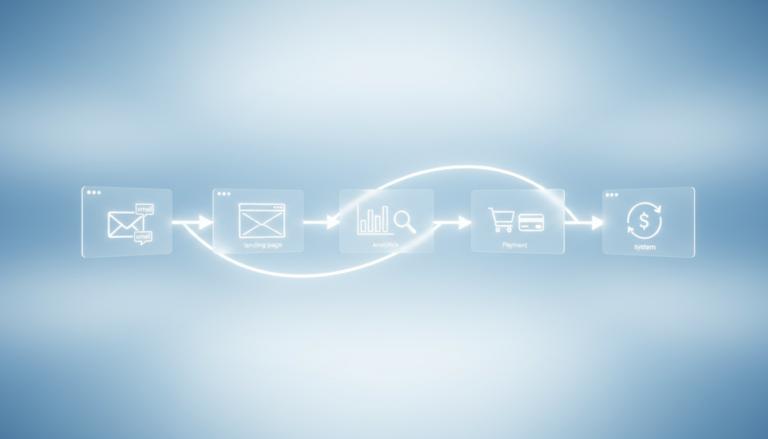
Improve and Scale
Common Mistakes Beginners Make When Starting an Online Business
Starting an online business is an exciting journey, but it’s also easy to become overwhelmed by the amount of advice available. Every day, new videos, blog posts and social media advertisements promise shortcuts to success, making it difficult for beginners to separate genuine business advice from unrealistic claims.
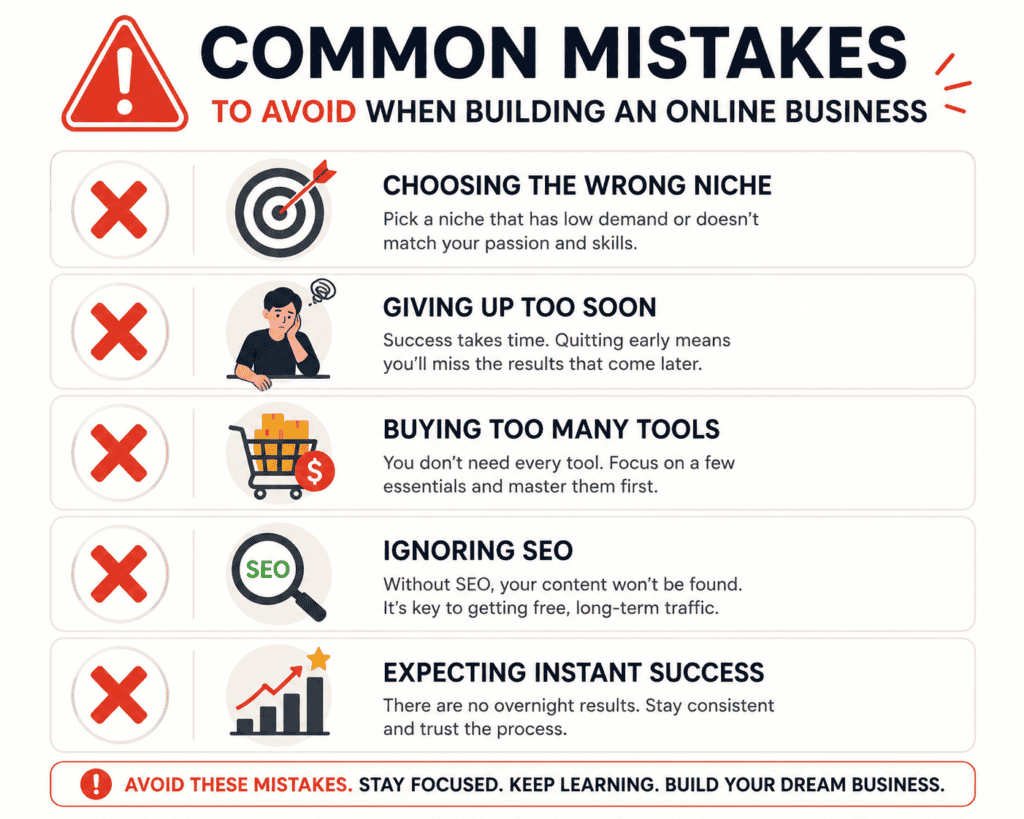
The good news is that many common mistakes can be avoided with the right mindset and realistic expectations. Understanding these pitfalls before you begin can save both time and money while helping you build a stronger foundation for long-term success.
Trying to Do Everything at Once
One of the most common mistakes is attempting to build multiple businesses simultaneously.
A beginner might decide to:
- Start a blog.
- Launch a YouTube channel.
- Open a dropshipping store.
- Sell on Amazon.
- Create digital products.
- Grow five different social media accounts.
While enthusiasm is valuable, spreading your time across too many projects often leads to slow progress in all of them.
Instead, choose one business model and focus on developing it until you’ve gained confidence and experience. Once you have established systems and understand what works, expanding into additional income streams becomes much easier.
Expecting Quick Results
Many online advertisements create the impression that making money online happens almost immediately.
In reality, building a sustainable online business usually takes time.
Search engines need time to discover and rank new websites. Audiences need time to build trust. Products often require testing and improvement before they begin selling consistently.
Rather than measuring success week by week, think in terms of months and years. Entrepreneurs who remain consistent are generally more likely to achieve long-term success than those constantly chasing the latest trend.
Choosing a Business Only Because It Looks Easy
It’s natural to be attracted to business models that appear simple or promise rapid profits.
However, every legitimate online business involves learning new skills, solving problems and serving customers.
Instead of asking:
“Which business makes money the fastest?”
Ask:
“Which business model fits my interests, skills and long-term goals?”
Choosing a business you genuinely enjoy working on makes it easier to remain motivated during the inevitable challenges.
Ignoring Your Audience
Some beginners become so focused on products and income that they forget the most important part of any business: helping people.
Successful businesses solve problems.
Before creating products or writing content, ask yourself:
- What questions are people asking?
- What problems do they need help solving?
- What information would genuinely improve their lives?
- How can I provide more value than competing websites?
Businesses built around helping people often develop stronger customer loyalty than those focused only on making sales.
Buying Too Many Tools
Modern software is incredibly powerful, but more software doesn’t automatically mean more success.
Many beginners subscribe to multiple premium tools before they’ve generated their first visitor or sale.
Instead, start with the essentials.
As your business grows, invest in additional software only when it clearly saves time, improves efficiency or supports your next stage of growth.
Remember:
A great business strategy will usually outperform an expensive collection of unused software.
Neglecting Search Engine Optimisation (SEO)
Many beginners spend hours creating content but never learn how people actually find it.
Basic SEO helps search engines understand your content and connect it with users searching for relevant information.
Simple improvements such as:
- Writing descriptive page titles.
- Using clear headings.
- Answering specific questions.
- Optimising images.
- Linking related articles.
can significantly improve your website’s visibility over time.
SEO is a long-term investment rather than a quick fix, but it can become one of the most reliable sources of free traffic.
Copying Competitors Instead of Building Your Own Brand
It’s sensible to learn from successful businesses, but simply copying competitors rarely creates lasting success.
Instead, focus on developing your own identity.
Consider:
- Your tone of voice.
- Your values.
- Your audience.
- Your expertise.
- The problems you solve.
People often remember businesses that communicate consistently and authentically rather than those trying to imitate everyone else.
Giving Up Too Soon
Perhaps the biggest mistake of all is quitting before your business has had time to grow.
Many websites receive very little traffic during their early months. That doesn’t necessarily mean the business is failing.
Search engines need time to evaluate new content, and audiences need repeated exposure before they begin trusting a new brand.
Every article you publish, every product you improve and every customer you help becomes another building block in your business.
Progress is rarely a straight line. Some months may feel slow, while others bring significant growth. Consistency is often the difference between businesses that succeed and those that never reach their potential.
Forgetting That Trust Is Your Greatest Asset
Online business isn’t just about websites, software or marketing strategies.
It’s about people.
Visitors choose to buy from businesses they trust.
That trust is built through:
- Honest advice.
- Accurate information.
- High-quality products.
- Transparent recommendations.
- Helpful customer support.
- Consistent communication.
Protecting your reputation should always take priority over chasing short-term profits.
A trusted brand is one of the most valuable assets an online business can build.
Key Takeaways
Before launching your online business, remember these principles:
Focus on one business model first.
Set realistic expectations and think long term.
Solve real problems for real people.
Invest in learning before expensive software.
Build trust through helpful content.
Improve consistently rather than chasing perfection.
Small, consistent actions taken over time often produce far greater results than trying to do everything at once.
Frequently Asked Questions About Building an Online Business
What is the easiest online business to start?
The easiest online business to start depends on your skills, interests and available time. For many beginners, affiliate marketing, blogging and freelancing are among the most accessible because they require relatively little upfront investment. If you already have professional skills such as writing, graphic design or programming, freelancing can provide one of the fastest routes to earning income. If you’re interested in building long-term assets, blogging and affiliate marketing may be better suited to your goals.
The most important factor is choosing a business model you can commit to consistently rather than searching for the “easiest” option.
Can I start an online business with no money?
Yes, it is possible to start certain online businesses with very little money. Business models such as blogging, affiliate marketing, freelancing and content creation can often be launched using free or low-cost tools. However, even low-cost businesses require an investment of time, effort and continuous learning.
As your business grows, you may choose to invest in better software, website hosting, marketing or product development to support further growth.
How long does it take to make money from an online business?
There is no guaranteed timeline.
Some freelancers secure their first client within weeks, while blogs and affiliate websites may take several months before generating consistent income. E-commerce businesses can sometimes make sales quickly but often require ongoing optimisation and marketing.
Rather than expecting immediate results, focus on building valuable content, improving your skills and serving your audience consistently.
Do I need a website to build an online business?
Not every online business requires a website immediately, but having one provides significant long-term benefits.
A website gives you control over your content, branding and customer experience. Unlike social media platforms, you own your website and decide how your business is presented.
For many business models, including affiliate marketing, blogging, digital products and professional services, a website becomes one of your most valuable business assets.
Which online business makes the most money?
There is no single business model that guarantees the highest income.
Successful entrepreneurs can build profitable businesses through affiliate marketing, Amazon FBA, dropshipping, freelancing, digital products, online courses, software services and many other models.
Income depends on factors such as:
- Market demand.
- Product or service quality.
- Marketing strategy.
- Consistency.
- Customer satisfaction.
- Long-term business planning.
Choosing a business model that matches your strengths is often more important than chasing the highest earning potential.
Is dropshipping still worth it?
Yes, dropshipping can still be a viable business model, but it is far more competitive than when it first became popular.
Successful dropshipping businesses generally focus on:
- Building a recognisable brand.
- Selecting quality products.
- Providing excellent customer service.
- Creating useful content.
- Developing trust with customers.
Rather than expecting instant profits, approach dropshipping as a genuine business that requires planning, testing and continuous improvement.
Is affiliate marketing still profitable?
Affiliate marketing continues to be a popular online business model because companies across many industries reward people for referring customers.
However, successful affiliate marketing is built on trust rather than simply placing links on a website.
People are far more likely to purchase products recommended by creators who consistently provide accurate, helpful and honest information.
Creating valuable content should always come before promoting affiliate products.
Can I run an online business while working full-time?
Yes.
Many successful online businesses begin as side projects.
Working on your business during evenings or weekends allows you to develop experience while maintaining the financial security of your regular employment.
As your business grows, you can gradually decide whether you wish to continue part-time or transition to running it full-time.
Do I need technical skills?
No.
Modern website builders, AI tools and beginner-friendly software have made online business much more accessible than it was in the past.
Although learning basic digital skills is helpful, most successful entrepreneurs develop those skills gradually through practice rather than starting as technical experts.
Being willing to learn is usually more valuable than already knowing everything.
Can artificial intelligence help me build an online business?
Artificial intelligence can assist with many business tasks, including brainstorming ideas, drafting content, creating images, analysing information, automating repetitive work and improving productivity.
However, AI works best as a support tool rather than a replacement for human judgement.
Successful businesses combine AI with original thinking, genuine expertise and a strong understanding of customer needs.
What is the biggest mistake beginners make?
One of the biggest mistakes is trying to build too many businesses at the same time.
Many beginners become overwhelmed because they attempt blogging, YouTube, dropshipping, Amazon FBA and social media marketing simultaneously.
Choosing one business model, developing your skills and building a solid foundation before expanding usually produces better long-term results.
What is the best online business for beginners?
There is no universal answer because every entrepreneur has different goals and strengths.
For example:
- If you enjoy writing, blogging or affiliate marketing may suit you.
- If you enjoy creating products, digital products or print-on-demand could be ideal.
- If you prefer selling physical products, dropshipping or Amazon FBA may be appropriate.
- If you have valuable professional skills, freelancing may provide the quickest route to income.
The best online business is the one that aligns with your interests, skills, available time and long-term objectives.
Final Thoughts
Learning how to build an online business can feel overwhelming at first, but every successful entrepreneur started exactly where you are now with questions, uncertainty and a willingness to learn.
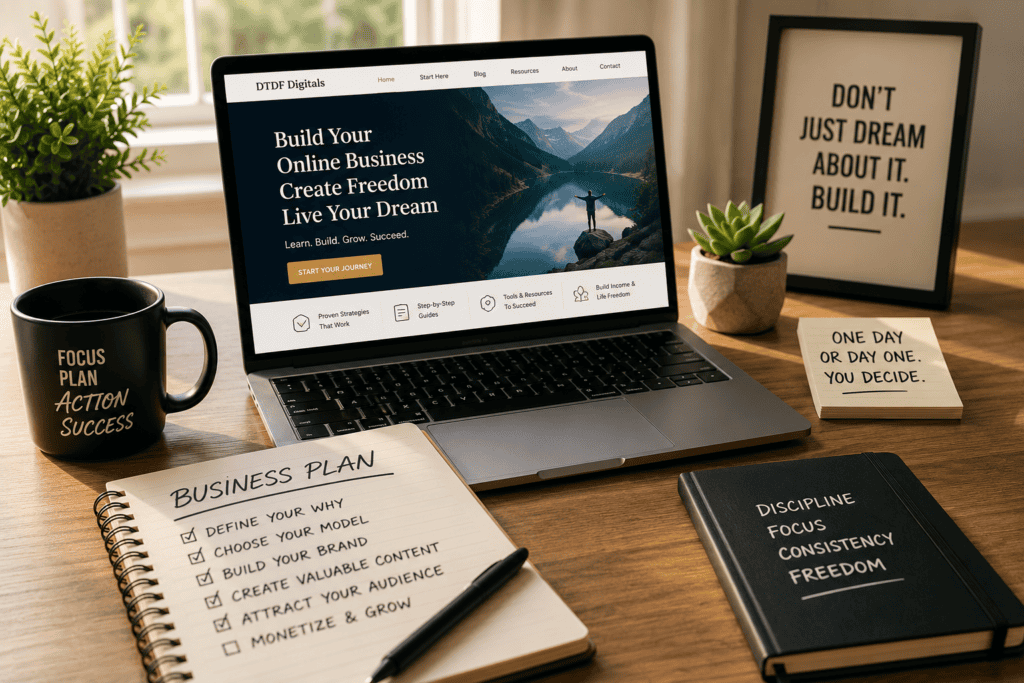
There is no perfect business model, no perfect website and no perfect moment to begin. What matters most is taking informed, consistent action. Whether you decide to build a blog, launch a dropshipping store, create digital products, sell through Amazon FBA, offer freelance services or promote software through affiliate marketing, long-term success comes from solving real problems and creating genuine value for your audience.
Remember that online businesses are rarely built overnight. They grow through continuous learning, testing ideas, improving your content and adapting to customer feedback. Every article you publish, every product you develop and every customer you help contributes to a stronger business foundation.
As technology continues to evolve, new opportunities will emerge, but the principles of successful online business remain the same: understand your audience, provide value, build trust and keep improving.
If you’re ready to begin, don’t wait until everything feels perfect. Choose one business model, learn the fundamentals, take your first step and build momentum one day at a time.
The journey may not always be easy, but with patience, consistency and a commitment to helping others, building a successful online business is an achievable goal for many aspiring entrepreneurs
Ready to Take the First Step?
If you’re ready to begin your online business journey, explore the beginner resources available on DTDF Digitals.
Whether you’re interested in affiliate marketing, blogging, dropshipping, Amazon FBA, AI tools or creating digital products, our goal is to help you build your business with practical guidance, trusted tools and straightforward advice.
Remember, every successful online business started with one decision: taking the first step.